
The Corona Municipal Plunge
Since our town’s inception, early residents enjoyed gathering outdoors, but it wasn’t until 1913 that Corona developed its first public park. Since then, Corona City Park on East Sixth Street has provided a space for leisure, community activities, and recreation.
In 1925, the City Council approved the construction of a pool and declared it a much-needed additional attraction. If you lived in Corona in the mid twentieth century, the City Park Plunge was more than a swimming pool; it was a community hub and a favorite spot for many privileged residents.
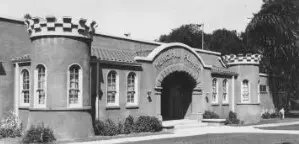
The Plunge building itself was unique to Corona, featuring eclectic Tudor-style castellated parapets atop circular towers, blended with a Mediterranean-Mission Revival tile roof.
What was not unique about the Plunge was the misguided practice of segregating public spaces that was all too common across the country.
The Jefferson Dissertation (UCSB, 2015), citing historian José M. Alamillo’s scholarship (p. 47), confirms that “when the municipal pool opened in 1925, Mexicans, Italians, and other ‘foreigners’ could only swim on Mondays, the day before the ‘dirty’ pool water was changed on Tuesdays, so it would be ‘clean’ for whites to swim in.”
From the plunge’s grand opening and throughout the 1930’s, the segregated schedule was openly acknowledged and reinforced. The city’s swim lesson schedule clearly limited Mexican kids to Mondays, and the Corona Daily Independent matter-of-factly reported that Mexican American children could swim only on Mondays.
Public discussions were increasingly focused on segregation, yet in early 1940, rather than considering integration, the Corona City Council discussed creating a separate Mexican Park on the outskirts of town.
Although efforts to end prejudice and segregation were extremely slow, the first signs of change at the Plunge came in 1934, when Nettie Ida Whitcomb was hired as manager. It was reported that a sign at the entrance read, “Mexican children allowed in the pool on Mondays only.” In a 1968 interview with the Corona Daily Independent, Whitcomb stated that she “took it down and burned it soon after she started.”
World War II ultimately hastened the end of discrimination at the Plunge. Hundreds of servicemen stationed at nearby Camp Haan visited Corona’s pool while on leave. Camp Haan was integrated, and Whitcomb welcomed every soldier with open arms, offering free swims, hot showers, towels, and even laundry service.
U.S. Army Private Joe M. Dominguez, a 1941 Corona Senior High graduate and one of Whitcomb’s former students, died fighting for our country at the Battle of Arawe, New Britain, on December 27, 1943, at the age of 22.
His sacrifice deeply touched the community.
Early in the 1944 season, according to eyewitness Tom Moffett, a Mexican American veteran arrived at the pool on a day other than Monday. Whitcomb declared, “If Mexican American citizens could fight for their country, they could swim in the pool any day of the week with their fellow Coronans.”
She then called the City Manager. The City Manager, City Attorney, and City Council did not overturn her decision.
The Plunge continued to serve all our residents for another two decades.
By the mid-1960s, the city declared that the once state-of-the-art pool was “beyond repair, unable to accommodate Corona’s surging population, which had more than tripled in just 40 years.”
A new pool was built on an open field behind the original, and the old Corona Plunge was demolished in the late 1960s.
Our parks remain among the city’s greatest treasures, offering beautiful green spaces for all. Recreational programs bring people together through sports leagues, fitness classes, and creative activities for all ages.